
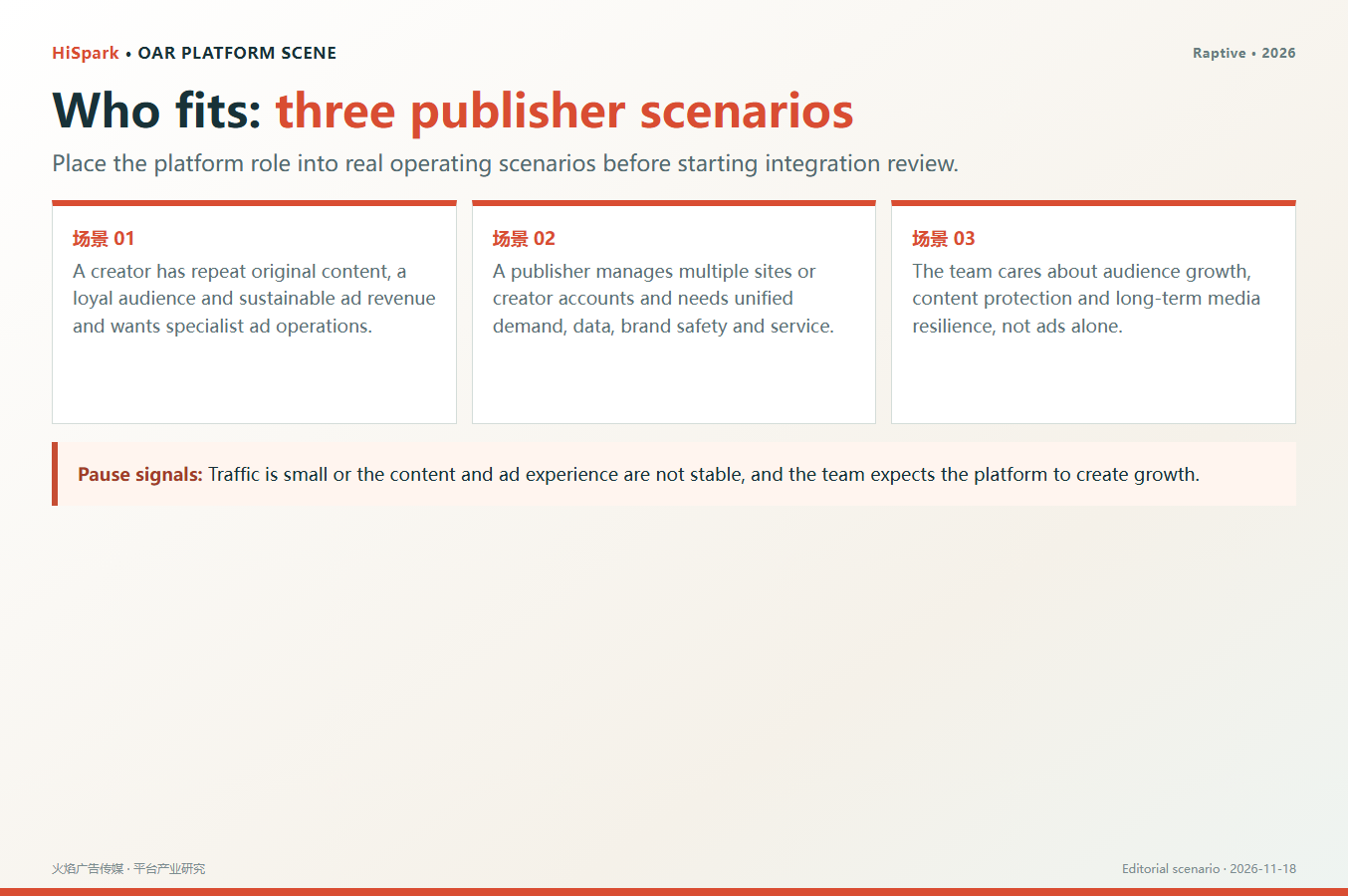
A creator has repeat original content, a loyal audience and sustainable ad revenue and wants specialist ad operations.

Raptive
Creator media network & managed ads · Publisher-side revenue operations
1. Platform role and category
Raptive describes itself as a global media company and creator network connecting independent creators, digital publishers, media brands and advertisers.
Advertising monetisation and demand management sit at the front, while audience growth, content protection, advocacy, expert services and data products sit behind it.
For a publisher, it is closer to a managed growth and monetisation partner than a code-only technology vendor.
2. Business model and commercial terms
The official Creators page advertises a 15% minimum RPM lift guarantee and an alternative guaranteed RPM with lower density and a smaller lift. Eligibility, measurement baseline, duration and exclusions must be confirmed in the contract.
Raptive offers creator levels and a separate media-company path, indicating that service and commercial terms are not identical for every publisher.
No uniform revenue share or payment schedule is published. Verify the share, guarantee calculation, traffic basis, placement requirements, brand-safety responsibility and post-termination data and code handling.
3. Where value comes from
Value levers
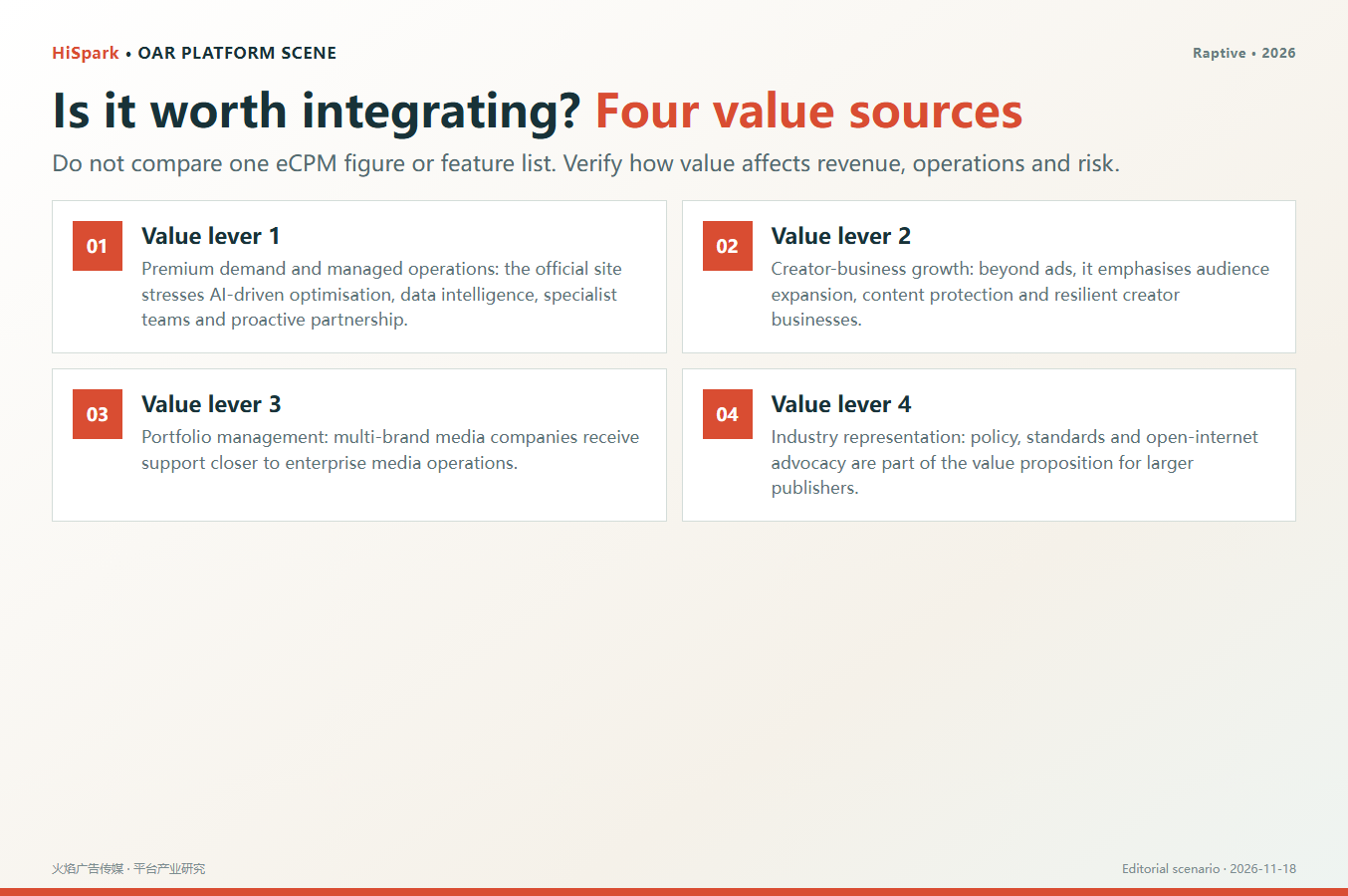
- Premium demand and managed operations: the official site stresses AI-driven optimisation, data intelligence, specialist teams and proactive partnership.
- Creator-business growth: beyond ads, it emphasises audience expansion, content protection and resilient creator businesses.
Operating value
- Portfolio management: multi-brand media companies receive support closer to enterprise media operations.
- Industry representation: policy, standards and open-internet advocacy are part of the value proposition for larger publishers.
4. Who fits, and who should wait
A good fit when
- A creator has repeat original content, a loyal audience and sustainable ad revenue and wants specialist ad operations.
- A publisher manages multiple sites or creator accounts and needs unified demand, data, brand safety and service.
- The team cares about audience growth, content protection and long-term media resilience, not ads alone.
Do not rush when
- Traffic is small or the content and ad experience are not stable, and the team expects the platform to create growth.
- The publisher cannot provide baseline data, traffic splits and placement controls needed to measure an RPM guarantee.
- The business depends on sensitive, grey-area or hard-to-review content categories.
- The team will only accept standard self-service access and does not want managed service or contract review.
5. A controlled integration path
- Determine whether the business follows the creator or media-company path and confirm the applicable level and service.
- Request the RPM guarantee baseline, traffic exclusions, density requirements, test period and remedy if the target is missed.
- Prepare the current ad stack, monthly revenue, leading countries, speed, consent and brand-safety policies.
- Run a like-for-like test by content, country and device, comparing RPM, viewability, speed, completion and organic search.
- Document data ownership, payment, ad-code treatment, content rights, termination and migration in the agreement.
6. AdSense, SSP and publisher optimisation are different roles
| Role | Category | What it primarily sells |
|---|---|---|
| Raptive | Creator network & managed ads | Creator growth, demand, technology and specialist services |
| Mediavine | Publisher network & managed monetisation | Curated publisher network, ad tech and management |
| AdSense | Publisher ad network | Base ad demand and self-service access |
| Freestar | Publisher operating system | Enterprise header bidding plus managed or Flex service |
A publisher can use multiple layers together. The decision is not which logo replaces another, but who controls demand, inventory, testing, data, compliance and operations.
7. Typical customer scenarios
Put the platform back into a real publisher or advertiser workflow. The same feature set can be valuable for one team and premature for another.
A publisher manages multiple sites or creator accounts and needs unified demand, data, brand safety and service.
The team cares about audience growth, content protection and long-term media resilience, not ads alone.
Pause signals
- Traffic is small or the content and ad experience are not stable, and the team expects the platform to create growth.
- The publisher cannot provide baseline data, traffic splits and placement controls needed to measure an RPM guarantee.
- The business depends on sensitive, grey-area or hard-to-review content categories.
- The team will only accept standard self-service access and does not want managed service or contract review.
8. How to judge whether the value is real
Do not reduce the decision to one headline metric. Value must be visible in revenue quality, operating hours, risk control and the ability to explain results to management.
| Value source | What to verify | Evidence |
|---|---|---|
| Premium demand and managed operations: the official site stresses AI-driven optimisation, data intelligence, specialist teams and proactive partnership. | Validate with live data, not a feature list. | Dashboard, contract, test page or implementation record. |
| Creator-business growth: beyond ads, it emphasises audience expansion, content protection and resilient creator businesses. | Validate with live data, not a feature list. | Dashboard, contract, test page or implementation record. |
| Portfolio management: multi-brand media companies receive support closer to enterprise media operations. | Validate with live data, not a feature list. | Dashboard, contract, test page or implementation record. |
| Industry representation: policy, standards and open-internet advocacy are part of the value proposition for larger publishers. | Validate with live data, not a feature list. | Dashboard, contract, test page or implementation record. |
Official product, documentation and case evidence
These screenshots come from official product, documentation, eligibility or case-study pages captured on 18 Nov 2026. They are included as visual evidence for the platform’s current public proposition, not as a guarantee of commercial terms.


9. Pre-integration evidence checklist
A platform introduction is not an integration recommendation. The following items should have an owner, a current artefact and a decision date.
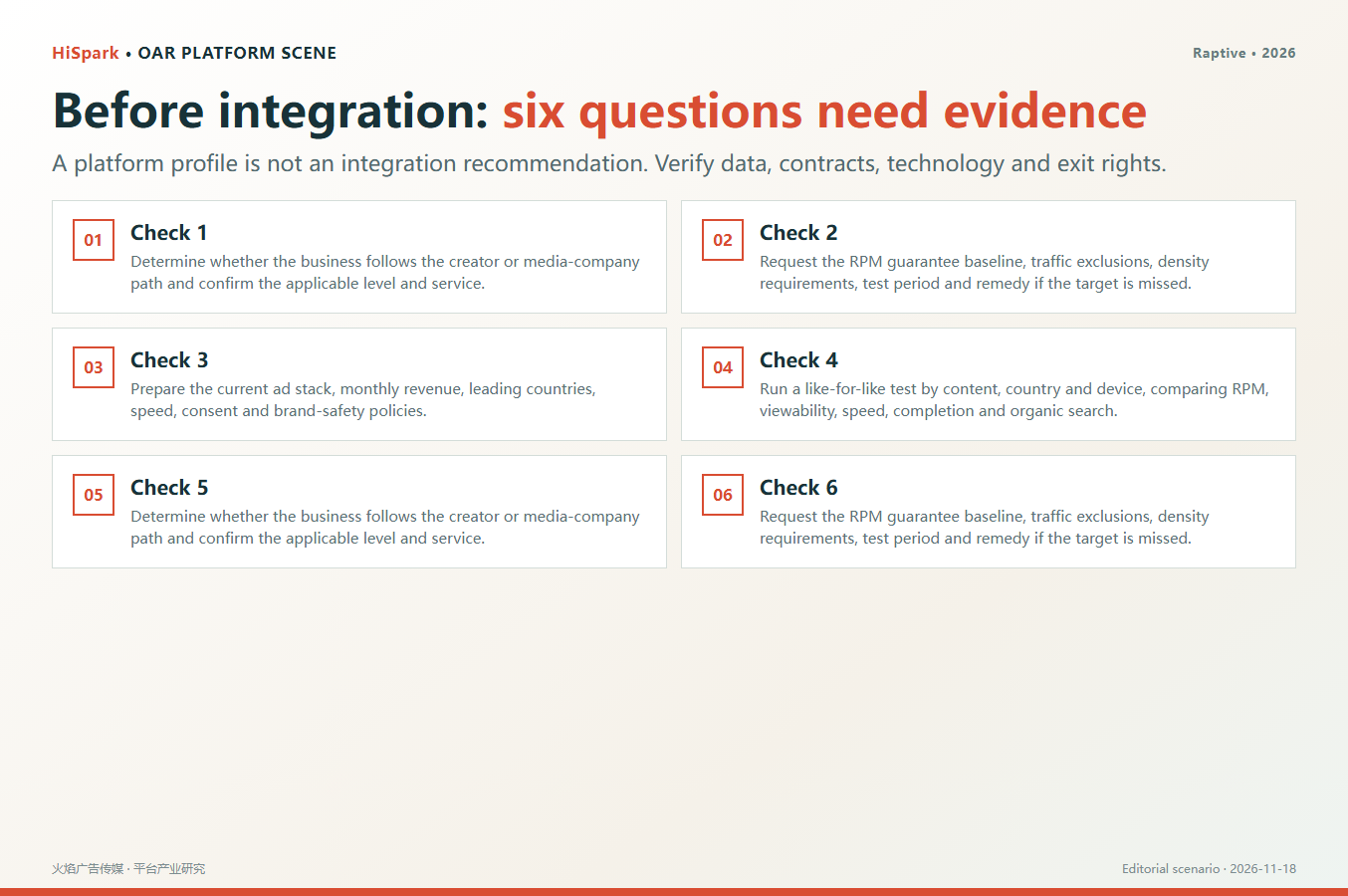
- Determine whether the business follows the creator or media-company path and confirm the applicable level and service.
- Request the RPM guarantee baseline, traffic exclusions, density requirements, test period and remedy if the target is missed.
- Prepare the current ad stack, monthly revenue, leading countries, speed, consent and brand-safety policies.
- Run a like-for-like test by content, country and device, comparing RPM, viewability, speed, completion and organic search.
- Document data ownership, payment, ad-code treatment, content rights, termination and migration in the agreement.
10. Five-minute fit scorecard
Use this as a decision aid, not a platform rating. Start from zero, add two points for each matching fit condition and deduct two for each pause signal.
| Score | Condition |
|---|---|
| ('+2', 'Already true') | A creator has repeat original content, a loyal audience and sustainable ad revenue and wants specialist ad operations. |
| ('+2', 'Already true') | A publisher manages multiple sites or creator accounts and needs unified demand, data, brand safety and service. |
| ('+2', 'Already true') | The team cares about audience growth, content protection and long-term media resilience, not ads alone. |
| ('-2', 'Deduct if true') | Traffic is small or the content and ad experience are not stable, and the team expects the platform to create growth. |
| ('-2', 'Deduct if true') | The publisher cannot provide baseline data, traffic splits and placement controls needed to measure an RPM guarantee. |
| ('-2', 'Deduct if true') | The business depends on sensitive, grey-area or hard-to-review content categories. |
8+ points: run a controlled pilot. 4–7: resolve missing evidence first. Below 4: wait or choose another platform role.
11. Four-stage validation plan
The goal is not to finish integration quickly. The goal is to produce evidence that can survive a commercial, technical and management review.
| Stage | Action |
|---|---|
| Week 1 | Determine whether the business follows the creator or media-company path and confirm the applicable level and service. |
| Week 2 | Request the RPM guarantee baseline, traffic exclusions, density requirements, test period and remedy if the target is missed. |
| Weeks 3-4 | Prepare the current ad stack, monthly revenue, leading countries, speed, consent and brand-safety policies. |
| Post-test | Run a like-for-like test by content, country and device, comparing RPM, viewability, speed, completion and organic search. |
Write the stop condition before the pilot starts. A platform test without a stop rule usually becomes an accidental permanent dependency.
12. Common failure modes
These are the situations that most often turn a platform introduction into wasted time or a migration problem.
Traffic is small or the content and ad experience are not stable, and the team expects the platform to create growth.
The publisher cannot provide baseline data, traffic splits and placement controls needed to measure an RPM guarantee.
The business depends on sensitive, grey-area or hard-to-review content categories.
13. Continue reading: adjacent platform roles
Compare adjacent roles instead of treating every platform as a substitute. The strongest stack usually combines complementary layers.
14. Frequently asked questions
How do Raptive, AdThrive and CafeMedia relate?
The official site states that CafeMedia and AdThrive became Raptive, carrying forward creator-network, ad-operations and media-company capabilities.
Does a 15% minimum RPM lift guarantee mean every site grows by 15%?
No. The site also presents a lower-density option, and the guarantee depends on baselines, eligibility, measurement windows and contract terms.
Does Raptive work only with individual bloggers?
No. It offers both creator and media-company paths, covering independent creators through multi-brand publishers.
What evidence is needed before choosing Raptive?
Current RPM and revenue baselines, leading markets, ad density, page speed, search traffic and engagement. Without a baseline a guarantee cannot be validated.