
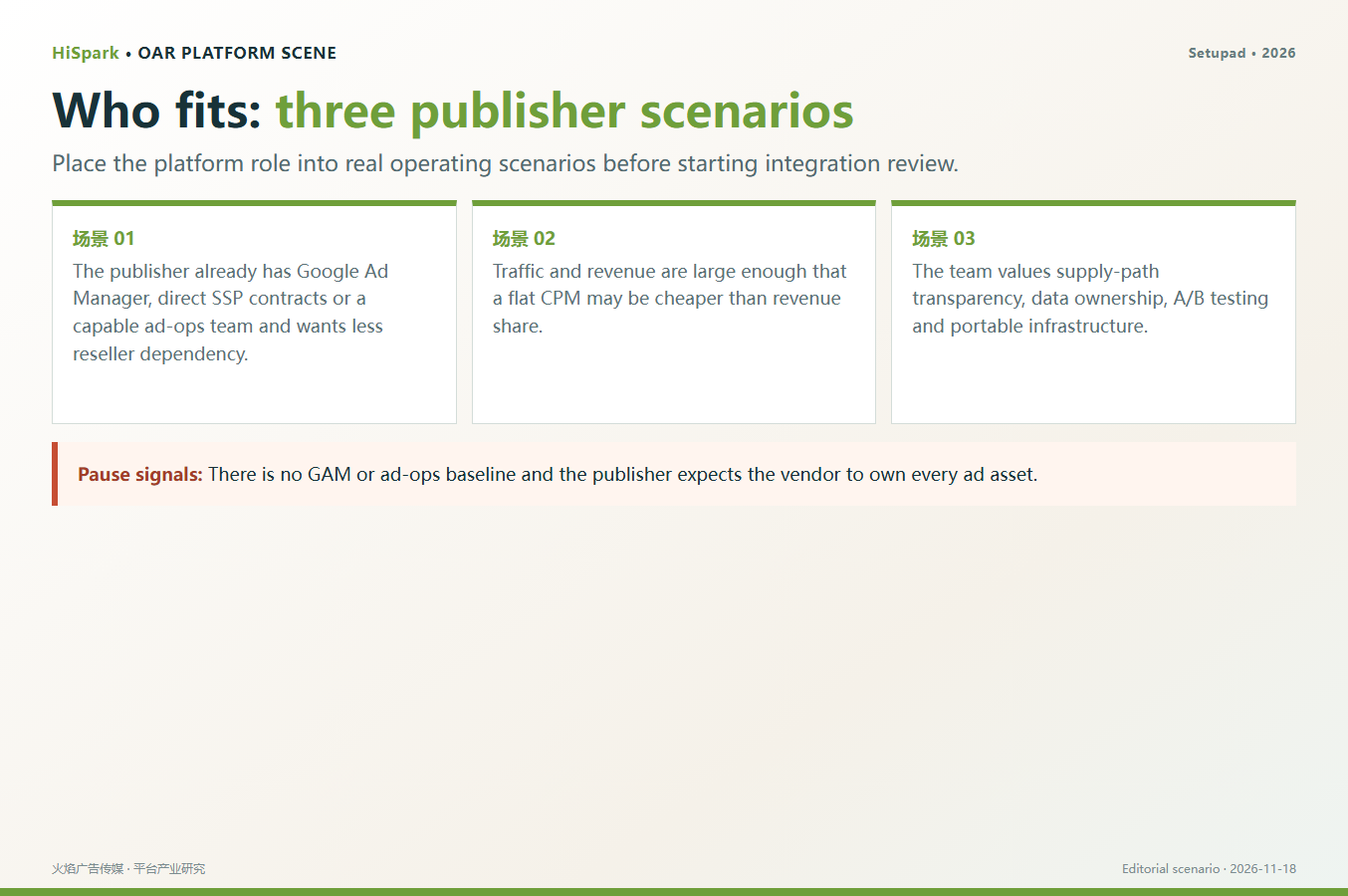
The publisher already has Google Ad Manager, direct SSP contracts or a capable ad-ops team and wants less reseller dependency.

Setupad
Prebid & GAM monetisation infrastructure · Publisher-side revenue operations
1. Platform role and category
Setupad provides Prebid, GAM sync, demand-partner introductions, real-time bid analytics, CMP and ad-ops support.
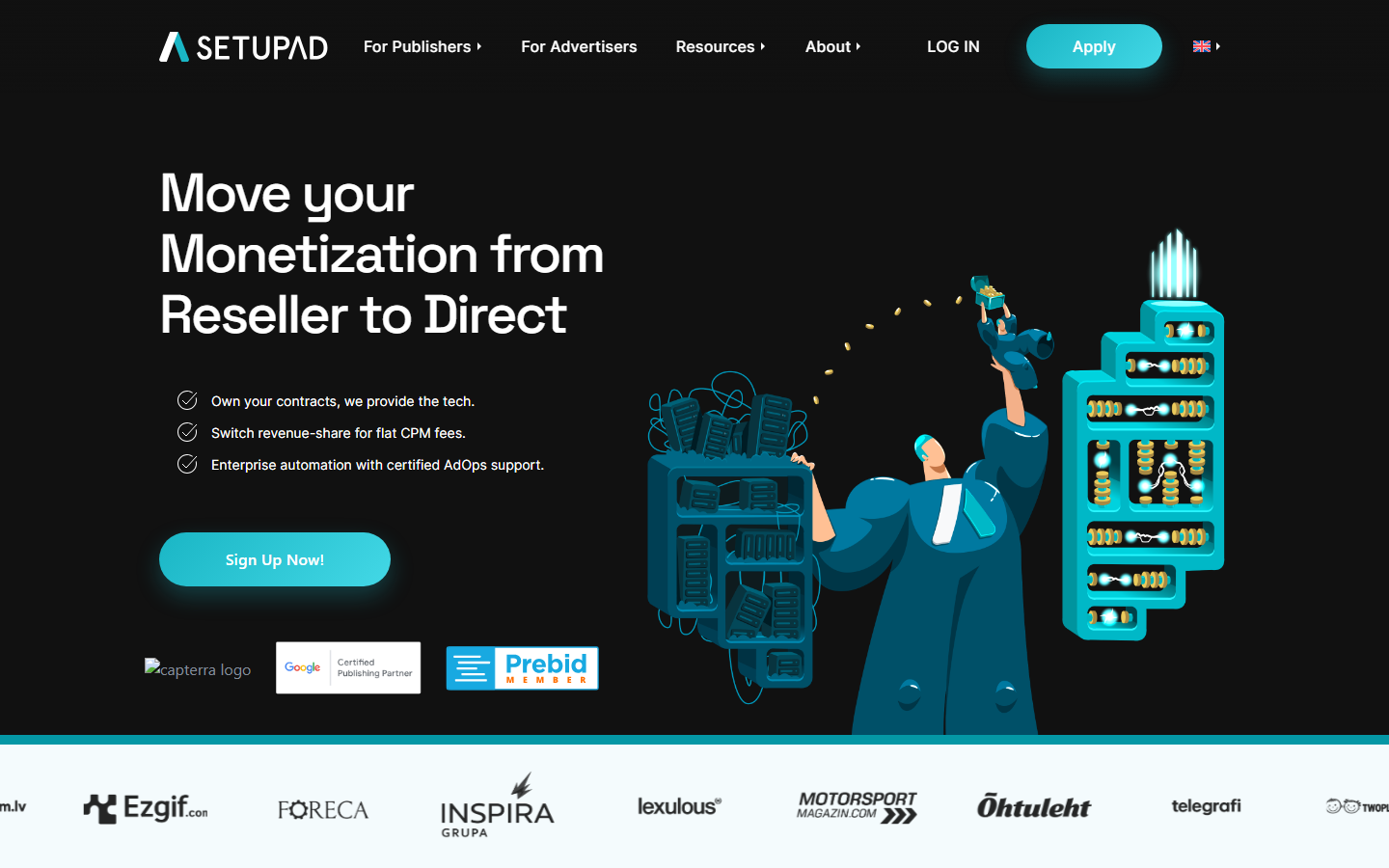
The official site positions it as infrastructure for moving from reseller structures to direct SSP relationships and publisher-controlled GAM.
It is not a pure SSP. It combines Prebid technology, an operations panel, consultancy and direct demand connections.
2. Business model and commercial terms
Setupad currently contrasts a roughly 20% revenue-share model with a predictable EUR 0.05 flat CPM cost. This is marketing and pricing context; actual fees depend on traffic, modules, currency and contract.
Self-Serve includes the Prebid Panel, GAM sync, bulk controls, A/B testing, CMP and real-time auction analytics; service depth depends on the selected package.
Direct SSP contracts mean the publisher owns the accounts and payment relationships while Setupad supplies technology and operations. Verify data access, minimum fees, demand responsibilities and stack ownership after termination.
3. Where value comes from
Value levers
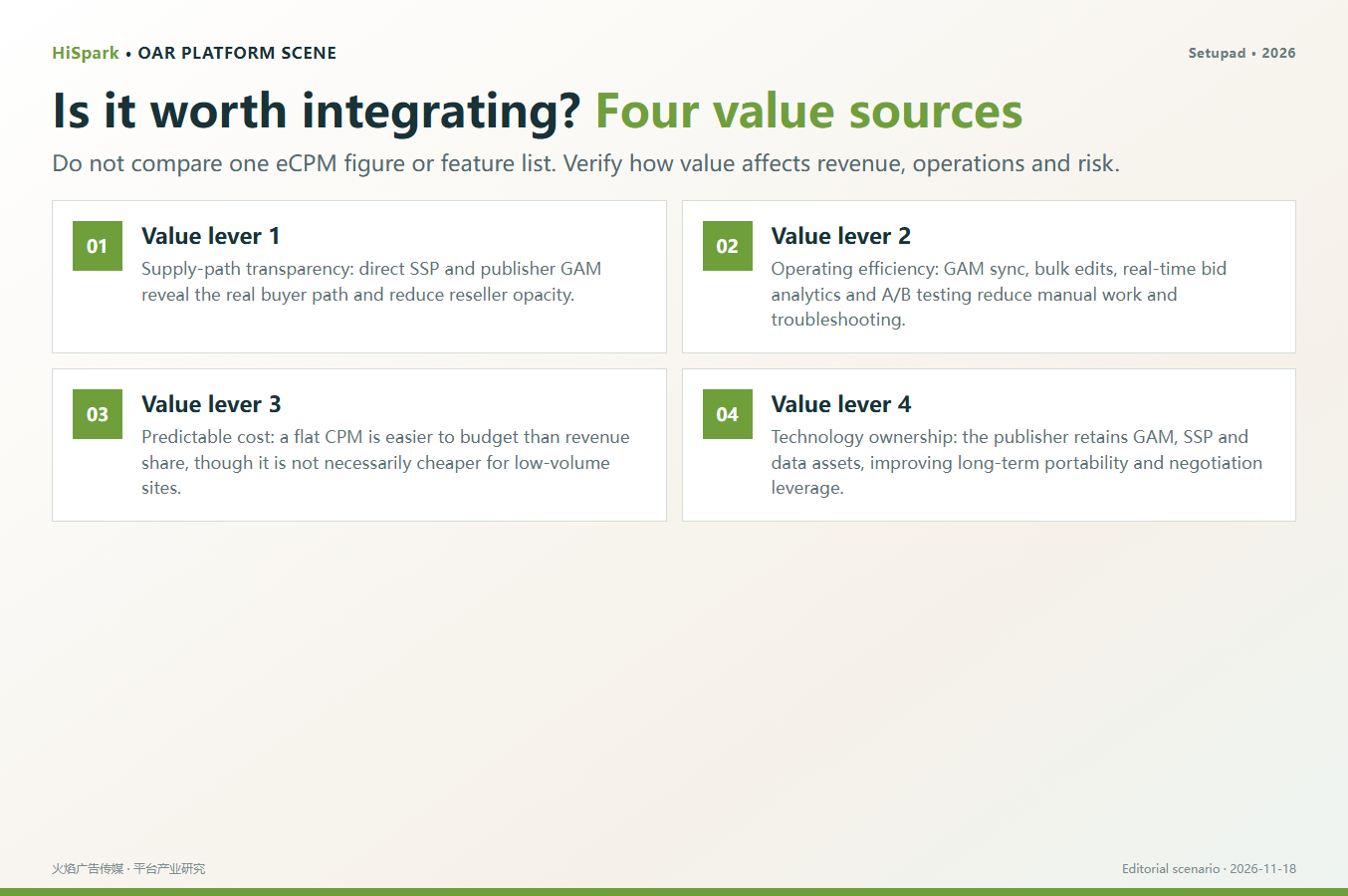
- Supply-path transparency: direct SSP and publisher GAM reveal the real buyer path and reduce reseller opacity.
- Operating efficiency: GAM sync, bulk edits, real-time bid analytics and A/B testing reduce manual work and troubleshooting.
Operating value
- Predictable cost: a flat CPM is easier to budget than revenue share, though it is not necessarily cheaper for low-volume sites.
- Technology ownership: the publisher retains GAM, SSP and data assets, improving long-term portability and negotiation leverage.
4. Who fits, and who should wait
A good fit when
- The publisher already has Google Ad Manager, direct SSP contracts or a capable ad-ops team and wants less reseller dependency.
- Traffic and revenue are large enough that a flat CPM may be cheaper than revenue share.
- The team values supply-path transparency, data ownership, A/B testing and portable infrastructure.
Do not rush when
- There is no GAM or ad-ops baseline and the publisher expects the vendor to own every ad asset.
- Traffic is too small for a flat CPM to beat revenue share or create sufficient demand competition.
- The team cannot invest time in demand contracts, GAM structure, CMP and ongoing optimisation.
- The business requires a fully closed ad-technology system.
5. A controlled integration path
- Map GAM accounts, direct SSPs, resellers, monthly impressions, markets and current revenue-share cost.
- Compare 12-month total cost across flat CPM, revenue share, technology maintenance and internal labour.
- Test real SSP and bidder latency, fill, eCPM, discrepancy and data completeness.
- Require a live walkthrough of GAM sync, bulk edits, A/B testing, CMP and change history.
- Define account ownership, SSP payment relationships, minimum fees, data export, SLA and exit migration.
6. AdSense, SSP and publisher optimisation are different roles
| Role | Category | What it primarily sells |
|---|---|---|
| Setupad | Prebid & GAM monetisation infrastructure | Direct transition, Prebid, GAM sync and flat CPM |
| Monumetric | Managed website ads & header bidding | Managed ad ops, video and DemandFusion |
| Freestar | Publisher operating system | Managed or Flex enterprise header bidding |
| PubMatic | Sell-side platform | Sell-side transactions, monetisation and demand |
A publisher can use multiple layers together. The decision is not which logo replaces another, but who controls demand, inventory, testing, data, compliance and operations.
7. Typical customer scenarios
Put the platform back into a real publisher or advertiser workflow. The same feature set can be valuable for one team and premature for another.
Traffic and revenue are large enough that a flat CPM may be cheaper than revenue share.
The team values supply-path transparency, data ownership, A/B testing and portable infrastructure.
Pause signals
- There is no GAM or ad-ops baseline and the publisher expects the vendor to own every ad asset.
- Traffic is too small for a flat CPM to beat revenue share or create sufficient demand competition.
- The team cannot invest time in demand contracts, GAM structure, CMP and ongoing optimisation.
- The business requires a fully closed ad-technology system.
8. How to judge whether the value is real
Do not reduce the decision to one headline metric. Value must be visible in revenue quality, operating hours, risk control and the ability to explain results to management.
| Value source | What to verify | Evidence |
|---|---|---|
| Supply-path transparency: direct SSP and publisher GAM reveal the real buyer path and reduce reseller opacity. | Validate with live data, not a feature list. | Dashboard, contract, test page or implementation record. |
| Operating efficiency: GAM sync, bulk edits, real-time bid analytics and A/B testing reduce manual work and troubleshooting. | Validate with live data, not a feature list. | Dashboard, contract, test page or implementation record. |
| Predictable cost: a flat CPM is easier to budget than revenue share, though it is not necessarily cheaper for low-volume sites. | Validate with live data, not a feature list. | Dashboard, contract, test page or implementation record. |
| Technology ownership: the publisher retains GAM, SSP and data assets, improving long-term portability and negotiation leverage. | Validate with live data, not a feature list. | Dashboard, contract, test page or implementation record. |
Official product, documentation and case evidence
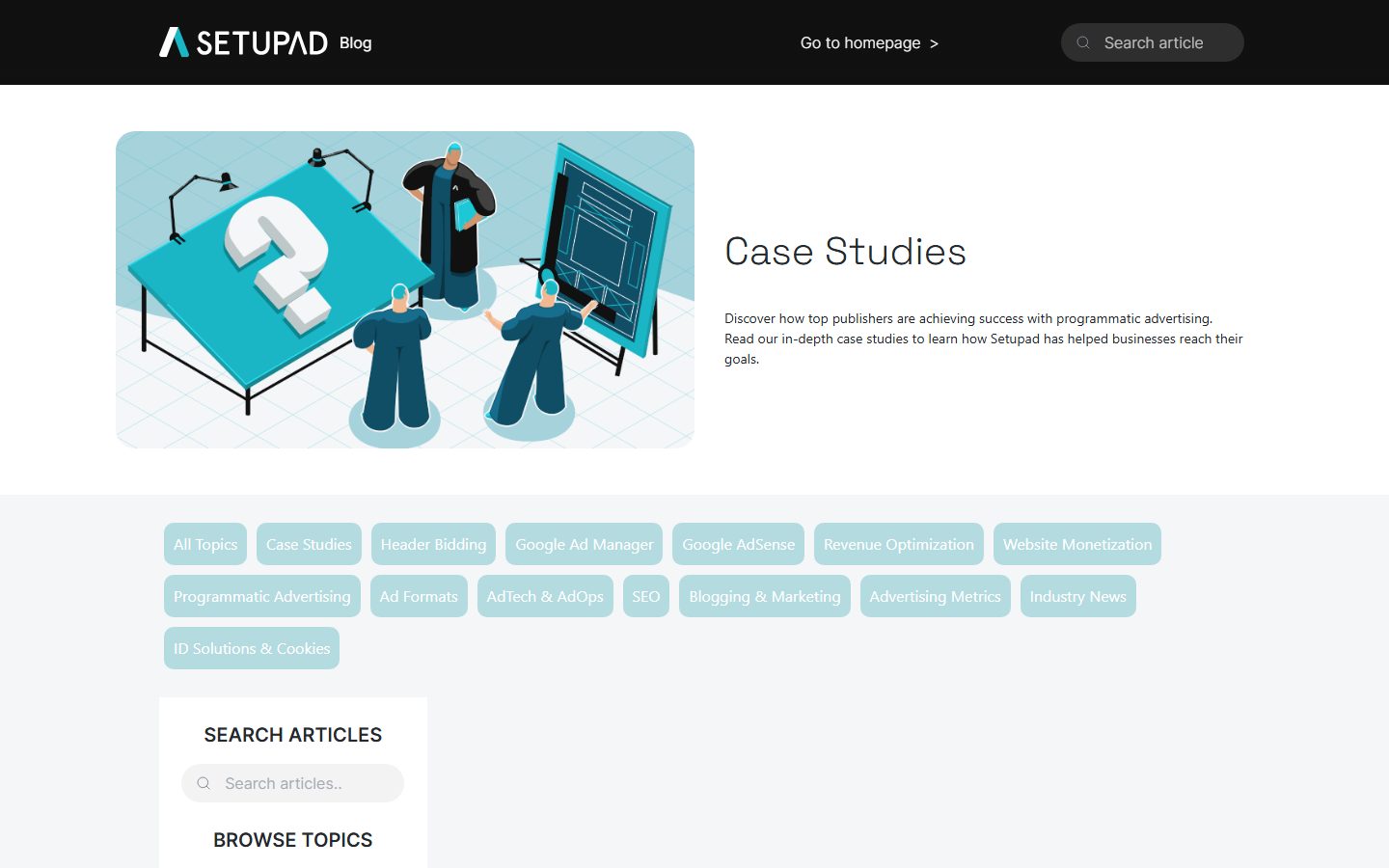
These screenshots come from official product, documentation, eligibility or case-study pages captured on 18 Nov 2026. They are included as visual evidence for the platform’s current public proposition, not as a guarantee of commercial terms.

9. Pre-integration evidence checklist
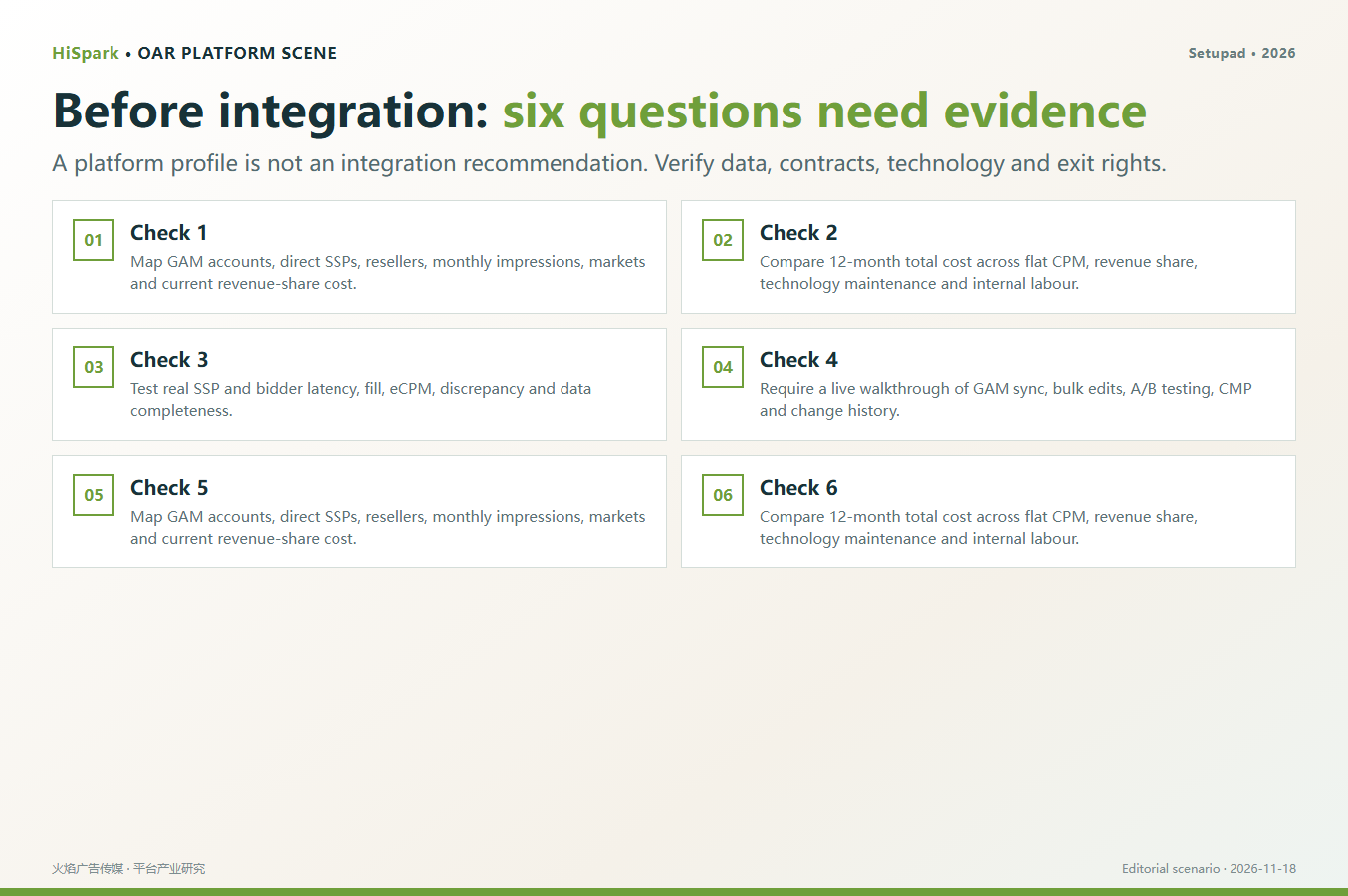
A platform introduction is not an integration recommendation. The following items should have an owner, a current artefact and a decision date.
- Map GAM accounts, direct SSPs, resellers, monthly impressions, markets and current revenue-share cost.
- Compare 12-month total cost across flat CPM, revenue share, technology maintenance and internal labour.
- Test real SSP and bidder latency, fill, eCPM, discrepancy and data completeness.
- Require a live walkthrough of GAM sync, bulk edits, A/B testing, CMP and change history.
- Define account ownership, SSP payment relationships, minimum fees, data export, SLA and exit migration.
10. Five-minute fit scorecard
Use this as a decision aid, not a platform rating. Start from zero, add two points for each matching fit condition and deduct two for each pause signal.
| Score | Condition |
|---|---|
| ('+2', 'Already true') | The publisher already has Google Ad Manager, direct SSP contracts or a capable ad-ops team and wants less reseller dependency. |
| ('+2', 'Already true') | Traffic and revenue are large enough that a flat CPM may be cheaper than revenue share. |
| ('+2', 'Already true') | The team values supply-path transparency, data ownership, A/B testing and portable infrastructure. |
| ('-2', 'Deduct if true') | There is no GAM or ad-ops baseline and the publisher expects the vendor to own every ad asset. |
| ('-2', 'Deduct if true') | Traffic is too small for a flat CPM to beat revenue share or create sufficient demand competition. |
| ('-2', 'Deduct if true') | The team cannot invest time in demand contracts, GAM structure, CMP and ongoing optimisation. |
8+ points: run a controlled pilot. 4–7: resolve missing evidence first. Below 4: wait or choose another platform role.
11. Four-stage validation plan
The goal is not to finish integration quickly. The goal is to produce evidence that can survive a commercial, technical and management review.
| Stage | Action |
|---|---|
| Week 1 | Map GAM accounts, direct SSPs, resellers, monthly impressions, markets and current revenue-share cost. |
| Week 2 | Compare 12-month total cost across flat CPM, revenue share, technology maintenance and internal labour. |
| Weeks 3-4 | Test real SSP and bidder latency, fill, eCPM, discrepancy and data completeness. |
| Post-test | Require a live walkthrough of GAM sync, bulk edits, A/B testing, CMP and change history. |
Write the stop condition before the pilot starts. A platform test without a stop rule usually becomes an accidental permanent dependency.
12. Common failure modes
These are the situations that most often turn a platform introduction into wasted time or a migration problem.
There is no GAM or ad-ops baseline and the publisher expects the vendor to own every ad asset.
Traffic is too small for a flat CPM to beat revenue share or create sufficient demand competition.
The team cannot invest time in demand contracts, GAM structure, CMP and ongoing optimisation.
13. Continue reading: adjacent platform roles
Compare adjacent roles instead of treating every platform as a substitute. The strongest stack usually combines complementary layers.
14. Frequently asked questions
Is Setupad an SSP?
Not purely. It connects SSPs and demand, but its core also includes Prebid, GAM sync, an operations panel, CMP and ad-ops support.
Is EUR 0.05 CPM always cheaper than 20% revenue share?
No. Compare total impressions, fill, eCPM, minimum fees and internal labour. Low-volume sites need particular care.
What does the publisher own after going direct?
Typically GAM, SSP accounts, payment relationships and data, subject to contract. Marketing pages are not a substitute for legal and financial verification.
Why is real-time bid analytics important?
It links latency, responses, timeouts, wins and revenue so the publisher can find actual losses caused by partners or configuration.